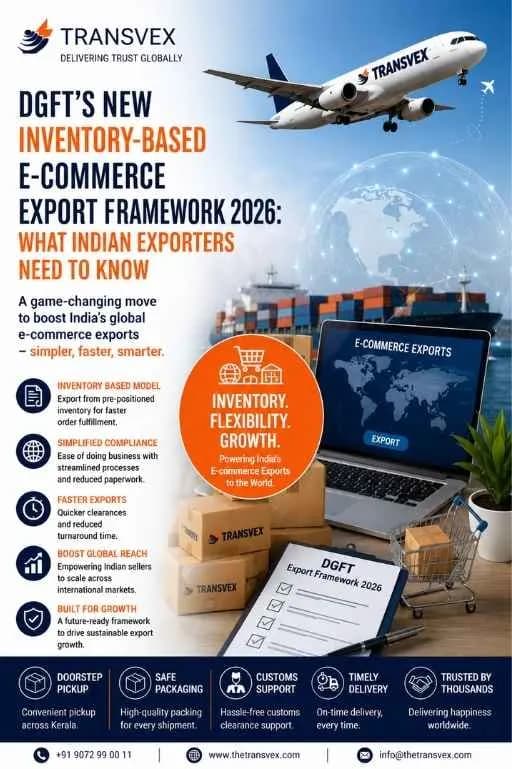

Selling Indian products to customers abroad is becoming more accessible, but international e-commerce still comes with complex inventory, customs, documentation, and compliance requirements. The DGFT Inventory-Based E-Commerce Export Framework 2026 aims to make this model more structured while creating a clearer route for Indian-made goods to reach global buyers.
The Directorate General of Foreign Trade (DGFT) operationalised the framework through Notification No. 27/2026-27 and Public Notice No. 25/2026-27, both dated August 5, 2026. The framework introduces the roles of Exporter-on-Record (EOR) and Seller-on-Record (SOR), along with specific rules for inventory, payments, returns, digital records, and export benefits.
For MSMEs, manufacturers, e-commerce businesses, and exporters in Kerala, the change could create new opportunities to sell Indian products internationally without every seller having to build a complete export operation from scratch.
What Is the DGFT Inventory-Based E-Commerce Export Framework 2026?
The DGFT Inventory-Based E-Commerce Export Framework 2026 creates a regulatory structure for export-only inventory operations under Chapter 9 of the Foreign Trade Policy 2023.
The framework allows eligible e-commerce entities to operate through a registered Exporter-on-Record. The model is specifically designed for goods manufactured or produced in India and does not permit speculative inventory build-up without a confirmed overseas order.
This development follows Press Note No. 3 of 2026, which permitted 100% FDI in inventory-based e-commerce when the operation is exclusively for exporting goods manufactured or produced in India.
In simple terms, the framework creates a bridge between Indian sellers, e-commerce businesses, and international customers while placing clear responsibility on the EOR.
EOR vs SOR: Who Does What?
One of the biggest changes is the formal separation of responsibilities between the Exporter-on-Record (EOR) and Seller-on-Record (SOR).
Exporter-on-Record
The EOR is the registered entity responsible for the export operation. It must hold a valid IEC and GSTIN and register with DGFT under the framework using ANF-9A.
The EOR handles areas such as:
- Export inventory management
- Export documentation
- Customs procedures
- Destination-country compliance
- Packaging and labelling requirements
- International fulfilment and logistics
- Reverse logistics for returned shipments
- Maintaining digital records
Seller-on-Record
The SOR is the Indian supplier that provides the goods to the EOR.
This can be particularly useful for manufacturers and MSMEs that have products suitable for international markets but do not want to independently manage every part of the export process.
The framework also gives sellers visibility into information such as final overseas sale price, order status, shipment tracking details, and destination country.
In short: the SOR supplies the Indian-made product, while the EOR manages the export operation.
Key Rules Indian Exporters Need to Understand
The new framework introduces several safeguards that businesses cannot treat as optional.
| Requirement | What It Means |
|---|---|
| Confirmed export order | Inventory cannot be transferred or built speculatively without a confirmed overseas order |
| Inventory segregation | Export inventory must be separately identified, tracked, and traceable |
| Digital repository | Procurement, GST invoices, inventory and export documents must be linked digitally |
| SOR payment | EOR must pay the SOR within 7 days of acceptance or deemed acceptance |
| Export benefits | Eligible seller-attributable benefits must be passed to the SOR |
| Returns | EOR manages reverse logistics and bears the associated costs |
| Domestic sale of returns | Returned or rejected export consignments cannot simply be sold in India |
The seven-day payment requirement is particularly important. Payment to the SOR cannot be delayed because the foreign customer has not yet paid or because the overseas buyer later returns the product.
Export Benefits Have a Separate Timeline
Where an EOR claims eligible Export Rebates and Refunds, the framework requires the seller-attributable portion to be passed to the SOR.
The operational procedures cap the EOR's administrative charge at 10% of the gross Export Rebates and Refunds, with the seller-attributable export benefits to be disbursed within 30 days of receipt by the EOR.
This creates greater financial visibility for Indian suppliers participating in the model.
How the New E-Commerce Export Process Works
The framework can be understood as a simple order-to-export chain.
1. A foreign customer places an order
The process begins with a confirmed overseas order. The framework does not allow speculative transfer of title or inventory accumulation simply because a product is expected to sell.
2. The EOR procures the product
The EOR obtains the required Indian-origin goods from the SOR and records the transaction digitally.
The inventory must remain clearly identifiable as export inventory rather than being mixed with goods intended for domestic sales.
3. Documentation and compliance are completed
The EOR is responsible for meeting applicable destination-country requirements, including product testing, certification, labelling, packaging, marking, and other market-access requirements.
4. The shipment moves through international logistics
Once documentation and compliance requirements are completed, the shipment can move through the appropriate courier, freight, or fulfilment network.
For Kerala-based e-commerce sellers and exporters, an experienced international courier service in Kerala can help with shipment handling, customs documentation, tracking, and international delivery.
What This Means for Kerala’s MSMEs and E-Commerce Sellers
Kerala has a strong base of businesses selling products such as spices, food products, textiles, handicrafts, jewellery, Ayurveda-related products, and other Indian-made goods.
The framework could make cross-border e-commerce more attractive because smaller sellers can potentially participate through an EOR structure instead of independently managing every export function.
However, easier market access does not mean compliance disappears.
Businesses still need accurate product information, appropriate packaging, correct invoices, destination-country compliance, and reliable shipment records.
For businesses operating from Kochi and surrounding commercial hubs, an experienced International Courier Service in Kochi can support the physical movement of orders once the required export process is completed.
Returns and Reverse Logistics Matter More Than Ever
Returns provide one of the major operational issues in cross-border e-commerce.
Under the framework, the EOR owns and manages reverse logistics for returned or rejected consignments and bears the associated costs. Returned goods received from overseas must be re-exported, returned to the SOR, or disposed of according to the prescribed process within the applicable timeline.
Importantly, returned export consignments cannot simply be sold in India's domestic market.
This means EORs should plan reverse logistics before scaling international sales. A low-cost outbound shipping model can quickly become expensive if returns, customs handling, storage, and disposal are ignored.
What Exporters Should Do Now
Businesses considering this model should build their processes around compliance from day one.
Practical checklist
- Confirm whether your business qualifies for the framework.
- Understand whether you will operate as an EOR or SOR.
- Complete EOR registration through ANF-9A, where applicable.
- Keep export and domestic inventory clearly separated.
- Build a digital system connecting orders, invoices, inventory, and shipping records.
- Define payment terms with SORs.
- Document responsibility for returns and rejected goods.
- Check destination-country product requirements before accepting orders.
- Choose logistics partners capable of handling international documentation and tracking.
- Maintain records needed for annual compliance certification.
The framework requires EORs to obtain an annual compliance certificate from an independent professional covering areas such as inventory segregation, seller payments, export-benefit calculations, seller visibility, and returned consignments. The certificate is generally required to be furnished to DGFT within 90 days of the end of the financial year.
For Kerala businesses shipping individual e-commerce orders overseas, reliable order-by-order fulfilment will become increasingly important. A Courier to UK from Kerala or a similar destination-specific service can be useful when delivery speed, tracking, customs support, and predictable handling matter.
The Bigger Opportunity for Indian E-Commerce Exports
The real significance of the 2026 framework is not simply the introduction of another export compliance process. It creates a more organised structure through which Indian manufacturers and MSMEs can participate in global e-commerce.
The combination of export-only inventory operations, registered EORs, seller visibility, digital traceability, and the new FDI flexibility could help Indian-made products reach international customers through more organised fulfilment networks. The government has specifically positioned the framework as a way to expand participation by manufacturers, artisans, and MSMEs in global e-commerce supply chains.
For businesses in Kerala, the opportunity is significant, but execution will matter. Strong products still need accurate documentation, compliant packaging, efficient fulfilment, reliable international shipping, and a clear returns process.
Frequently Asked Questions
1. What is the DGFT Inventory-Based E-Commerce Export Framework 2026?
It is a regulatory framework for export-only inventory operations under India's Foreign Trade Policy. It allows eligible businesses to operate through registered Exporter-on-Record (EOR) entities and applies to Indian-origin goods.
2. What are EOR and SOR under the new framework?
The Exporter-on-Record (EOR) is the registered entity responsible for managing the export operation, while the Seller-on-Record (SOR) is the Indian supplier providing goods to the EOR for export.
3. What is ANF-9A, and who needs to register?
ANF-9A is the prescribed form for EOR registration under the new framework. Eligible entities operating as EORs need to complete the required DGFT registration process.
4. Can businesses build export inventory before receiving an overseas order?
No. The framework does not permit speculative inventory build-up or transfer of title without a confirmed export order. Export inventory must also be properly segregated and digitally traceable.
5. How does the framework handle SOR payments, returns, and export benefits?
The EOR must pay the SOR within seven days of accepting or deeming the goods accepted. Returned or rejected export consignments cannot simply be sold in the domestic market, while eligible seller-attributable export benefits must be passed on according to the prescribed rules.
6. Does the framework allow FDI, and how does it help MSMEs?
Yes. Press Note No. 3 of 2026 permits 100% FDI in inventory-based e-commerce when the business exclusively exports goods manufactured or produced in India. The framework can also help MSMEs reach international customers through an EOR without having to build every export and logistics function themselves.
Conclusion
The DGFT Inventory-Based E-Commerce Export Framework 2026 creates a more defined route for Indian-made products to enter international e-commerce markets. Its EOR and SOR structure separates supply from export responsibilities while introducing clear rules for inventory, payments, digital records, returns, and export benefits.
For Kerala's MSMEs, manufacturers, and online sellers, the framework could open new opportunities to reach customers beyond India. But success will depend on more than simply listing products online, because compliant documentation, inventory control, destination-country requirements, and reliable international fulfilment remain essential.
If your business is preparing to ship products internationally, choosing the right logistics partner can make the process much easier. Transvex supports international courier and cargo requirements from Kerala with shipment tracking, customs documentation assistance, and worldwide delivery solutions.