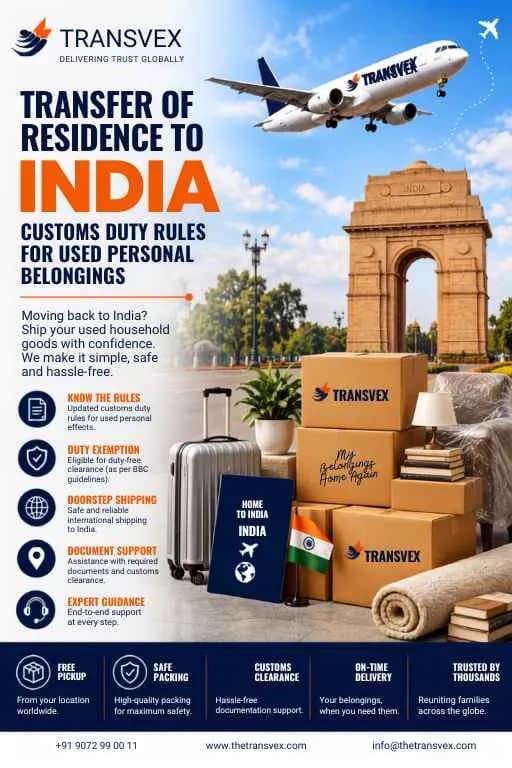

Moving back to India can be exciting, but shipping years of personal belongings can quickly become complicated. Understanding the transfer of residence to India rules before you pack can help you avoid unexpected customs duty, delays, and clearance issues.
India's Baggage Rules, 2026, provide specific duty-free benefits for eligible people relocating to India. These rules cover personal and household articles, including several appliances and electronic items, subject to eligibility, item limits, and an overall value cap.
If you are an NRI, returning professional, student, or person of Indian origin moving home, knowing what qualifies as unaccompanied baggage and how it works can make the relocation much smoother.
What is the transfer of Residence to India?
Transfer of Residence (TR) is a customs facility for eligible passengers returning to India or relocating to India. Under the Baggage Rules, 2026, residents or tourists of Indian origin who are transferring their residence can receive a duty-free allowance in addition to their normal baggage allowance. Eligible foreign nationals with a valid non-tourist visa can also qualify under separate conditions.
The rules distinguish between ordinary personal baggage and goods brought as part of a genuine relocation. Personal effects generally refer to articles a passenger may reasonably need for personal use during the journey, while commercial goods are excluded.
Are used personal belongings subject to customs duty in India?
Not necessarily. Used personal effects needed for daily necessities can generally enter duty-free under the rules, while eligible transfer-of-residence goods can receive additional duty-free benefits within the applicable limits. However, restricted, excluded, commercial, or excess-value goods can attract customs duty or require additional compliance.
Pro Tip: Do not treat "used" as a blanket exemption. Customs eligibility depends on the category of the item, its value, quantity, and whether it is genuinely personal or household baggage.
How Much Duty-Free Allowance Do You Get?
The Baggage Rules, 2026 simplified Transfer of Residence concessions into three main value slabs for residents and tourists of Indian origin:
| Stay Abroad | Maximum TR Value | Key Conditions |
|---|---|---|
| 3 to 12 months | ₹1.5 lakh | Personal and household articles, including eligible Annexure II items, generally limited to one unit each |
| 1 to 2 years | ₹3 lakh | Minimum one year abroad during the preceding two years; concession cannot have been used in the preceding three years |
| 2 years or more | ₹7.5 lakh | Two years immediately preceding arrival, short visits to India during those two years not exceeding six months, and no TR concession in the preceding three years |
The ₹7.5 lakh benefit is therefore not an unlimited duty-free household shipment. It is an aggregate value limit, and the eligible goods must fall within the categories permitted under the rules.
For the two-year condition, a shortfall of up to two months may be condoned in certain circumstances such as terminal leave, vacation, or other special circumstances. Excess short visits may also be condoned in deserving cases by the appropriate senior customs authority.
CTA: Planning your relocation? Prepare your inventory and shipment details before booking international cargo so the goods can be assessed against the applicable customs allowance.
What Household Items Can I Bring to India Duty Free?
The current rules allow eligible personal and household articles within the applicable TR value limit. The list includes several everyday appliances and electronics, but many have a one-unit limit.
Examples listed under Annexure II include:
- • Air conditioners
- • Microwave ovens
- • Washing machines
- • Gas cooking ranges
- • Desktop computers
- • Laptops or notebooks
- • Domestic refrigerators
- • Dishwashers
- • Deep freezers
- • Vacuum cleaners
- • Air fryers
- • Gaming consoles
- • Tablets
- • Air purifiers
- • Printers
- • Projectors
- • Musical instruments
- • Water dispensers
- • Electric ovens
The complete Annexure II list contains 30 categories under the 2026 rules. These items can be brought under the TR concession, subject to the applicable aggregate value and one-unit conditions.
Bringing electronics to India when moving back
Electronics require particular attention because they are not all treated the same way. For example, televisions appear in Annexure I, while televisions are also included in the Annexure II TR list, meaning the specific TR provisions and value limits must be considered rather than assuming every TV is automatically duty-free.
Similarly, an appliance being old or used does not automatically make it exempt from customs duty. Check the current classification and applicable TR conditions before shipping high-value electronics.
What Items Are Excluded or Restricted?
Annexure I contains items that are excluded from the ordinary duty-free treatment under the relevant rules. These include:
- Firearms
- Firearm cartridges above the permitted quantity
- Excess cigarettes, cigars, or tobacco
- Alcoholic liquor or wine above two litres
- Gold or silver in forms other than ornaments
- Television
Commercial quantities are another major concern. Customs guidance makes clear that goods imported in commercial quantities are not treated as bona fide passenger baggage simply because the passenger is willing to pay duty.
If you are unsure about an item, declare it rather than trying to hide it inside household cartons.
Shipping Personal Belongings to India as Unaccompanied Baggage
Large household shipments usually cannot travel as ordinary accompanied baggage. They may instead be sent as unaccompanied baggage, including through air freight or sea freight.
Under the 2026 rules, unaccompanied baggage must generally have been in the passenger's possession abroad. It may be dispatched within one month after the passenger's arrival in India. Customs may also permit baggage to arrive up to two months before the passenger, and in exceptional circumstances, the period may be extended for reasons recorded in writing.
This makes shipment planning important. Your relocation company or customs representative should coordinate the passenger's travel date, cargo departure, shipping documents, and customs clearance timeline.
Documents to keep ready
A practical relocation file should include:
- Passport and relevant travel records
- Detailed packing list or inventory
- Commercial or valuation documents, where applicable
- Bill of Lading for sea freight or Air Waybill for air freight
- Shipping and consignee details
- Customs declaration information
- Supporting documents for restricted or special-category goods
The CBIC's ATITHI platform also provides a Transfer of Residence filing facility for eligible passengers.
CTA: If you are shipping several cartons or a full household, consider using a logistics partner experienced in international relocation and customs documentation.
Step-by-Step Customs Clearance Process
The exact process can vary depending on the customs station and shipment type, but the general flow is:
1. Prepare the inventory
Create an accurate item-by-item list with quantities and reasonable values.
2. Ship the goods
Choose air freight for urgent or smaller consignments and sea freight for larger household shipments.
3. Submit customs documentation
Provide the required passenger, shipment, and declaration documents.
4. Customs assessment
Customs may review the documents, assess the goods, and conduct examination where required.
5. Pay applicable duty
If any goods fall outside the duty-free allowance or applicable concession, customs duty and other charges may apply.
6. Clearance and delivery
Once customs requirements are completed, the shipment can be released for delivery.
Common Mistakes When Moving Household Goods to India
Several avoidable mistakes might cause excessive delays:
- Assuming every used item is automatically duty-free
- Packing commercial quantities
- Failing to declare restricted goods
- Using vague descriptions such as "household items" for an entire shipment
- Giving incorrect or unrealistic item values
- Ignoring the one-unit condition for listed appliances
- Shipping without coordinating the cargo arrival with the passenger's travel
- Relying on outdated 2016 customs information
Quick Tip: Because the Baggage Rules changed in 2026, always check the current rules before finalising your packing list. Older blogs may still quote the previous ₹5 lakh TR limit and outdated Annexure structure.
Frequently Asked Questions
Can I bring my household goods to India without paying customs duty?
Eligible residents and tourists of Indian origin can receive Transfer of Residence benefits subject to the applicable value limit, item restrictions, and eligibility conditions. The maximum current TR allowance for the 2+ year category is ₹7.5 lakh.
Can I bring a TV duty-free when moving to India?
Televisions are specifically listed in Annexure I and also appear in the TR Annexure II list, so you should not assume a television is automatically duty-free. Its treatment depends on the applicable TR provisions and value limit.
How long can unaccompanied baggage arrive after I reach India?
Generally, unaccompanied baggage should be dispatched within one month of your arrival. Customs may allow baggage to arrive up to two months before you, with longer extensions possible in exceptional circumstances.
Can I ship furniture when transferring my residence?
Household articles may qualify under the TR concession if they meet the applicable requirements and fall within the permitted categories and aggregate value. Commercial quantities or goods outside the permitted categories may receive different treatment.
Is a laptop covered under Transfer of Residence?
Yes. A laptop or notebook is included in the current Annexure II list for TR purposes, subject to the applicable one-unit and aggregate value conditions. Separately, passengers aged 18 or above also have a general allowance for one new laptop under the 2026 rules.
Can I send my belongings before I arrive in India?
Yes. The 2026 rules allow unaccompanied baggage to arrive up to two months before the passenger, subject to customs approval and the prescribed conditions.
What happens if my shipment exceeds the duty-free limit?
Goods outside the applicable concession may be assessed for customs duty and other applicable charges. Customs valuation and classification determine the amount payable.
Conclusion
A successful transfer of residence to India starts well before your shipment reaches an Indian port. The key is to understand your eligibility, calculate the applicable TR value limit, and separate eligible household goods from restricted or excluded items.
The Baggage Rules, 2026 have simplified the TR framework, with allowances of ₹1.5 lakh, ₹3 lakh, and ₹7.5 lakh depending on the relevant eligibility category. However, these benefits still come with conditions around residence history, item categories, quantities, and documentation.
If you are shipping your belongings from overseas to India, careful packing and accurate documentation can make customs clearance far easier. For larger relocations, working with an experienced international logistics partner can also help coordinate freight, documentation, customs handling, and final delivery.